www.thepalio.eu - dal Belgio con amore
Palio di Siena of 2 July 2026: Ismaele Nones’ Drappellone unveiled

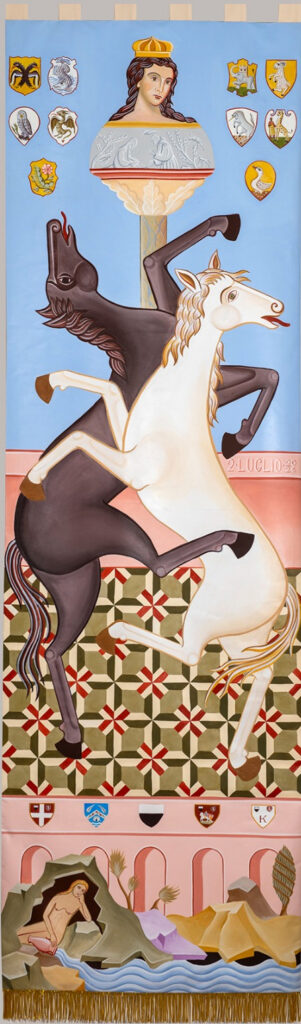
On Thursday evening, 26 June, the Drappellone (the traditional victory banner) for the Palio of 2 July 2026 was officially unveiled in the Cortile del Podestà. The artwork was created by Ismaele Nones, dedicated to the Madonna di Provenzano and commemorating the 800th anniversary of the death of Saint Francis of Assisi.
Following the traditional trumpet fanfare and an opening address by the Mayor of Siena, Nicoletta Fabio, art historian and curator Davide Ferri presented and explained the artwork. After the race, the Drappellone will become part of the museum collection of the Contrada that wins the Palio on 2 July.
The artwork
The Drappellone is conceived as a single, unified composition with a strong visual and conceptual coherence. For ease of interpretation, however, it can be divided into three sections: an upper, central and lower part.
At the top of the banner stands the Madonna di Provenzano, to whom the July Palio is dedicated. She is depicted with her two essential attributes: her crown and the nineteenth-century silver covering that serves as her mantle. This covering also recalls the riza, the metal overlay commonly found on Orthodox icons.
Because the silver mantle lacks decorative ornamentation, the artist transformed it into a narrative space within the composition. Inspired by ancient Roman breastplates, which were often decorated with reliefs celebrating military victories and heroic deeds, Nones chose to depict Saint Francis here in honour of the 800th anniversary of his death.
The saint is portrayed alongside his faithful companion, Brother Benedetto da Piratro, while dictating the so-called Little Testament of Siena of 1226. Besides its great historical importance, this document symbolises the longstanding connection between Saint Francis and the city of Siena. Around him, numerous birds fly joyfully through the sky, an iconic feature traditionally associated with depictions of the saint.
The Madonna stands upon a column, a choice that is both compositional and symbolic. Traditionally, the column is associated with the Virgin Mary as it represents the link between heaven and earth.
On either side of the Madonna, the ten Contrade taking part in the race are arranged symmetrically in two groups of five.
Beneath the Madonna, two horses dance and challenge one another beneath a clear blue sky. One horse is white, the other black. Their colours refer to the legend that Siena’s black-and-white coat of arms, the Balzana, originated from the horses ridden by the brothers Senio and Ascanio, the legendary founders of Siena and Asciano, as they fled from their uncle Romulus.
The horses are portrayed in a joyful spirit of competition. Their movements evoke the world of the absurd and the irrational, while at the same time they appear almost as mirror images of one another. Their closeness suggests that each exists because of the other. In this way, the artist reminds us that at the heart of every rivalry lies the joy of play. The Drappellone thus presents the Palio as a space where opposites meet, recognise one another and, symbolically, embrace.
The dance of the two horses unfolds upon an elaborately decorated floor that forms an idealised piazza. Its pattern is inspired by the floor of the Sala del Pellegrinaio in Santa Maria della Scala. Behind the horses, a city wall encloses the scene, bearing the date of the Palio: 2 July 2026.
Below this festive square runs a second city wall featuring the three historic districts (Terzi) of Siena, the Mayor’s coat of arms and, at its centre, the Balzana. Beneath the walls stretches a landscape of rolling hills, evoking the distinctive Sienese countryside and the inseparable bond between the city and its surrounding territory.
At the very bottom appears the allegorical figure of Diana, after whom the legendary underground river said to flow beneath Siena is named. Depicted with a resigned and somewhat bored expression, Diana still awaits her discovery, becoming an ironic yet melancholic figure suspended between myth, longing and collective memory.
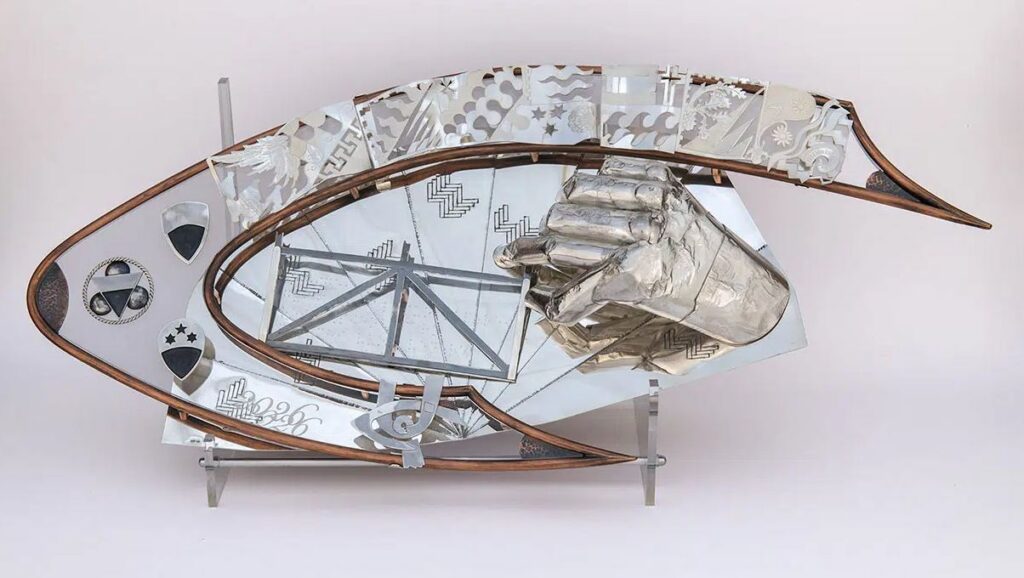
Alongside the Drappellone, the Masgalano—the prize awarded to the Contrada that presents the finest appearance during the two Corteo Storico processions of 2026—was also unveiled. This year’s Masgalano has been donated by the Unione Italiana dei Ciechi e degli Ipovedenti (Italian Union of the Blind and Visually Impaired) and was created by Antonio Benocci.